
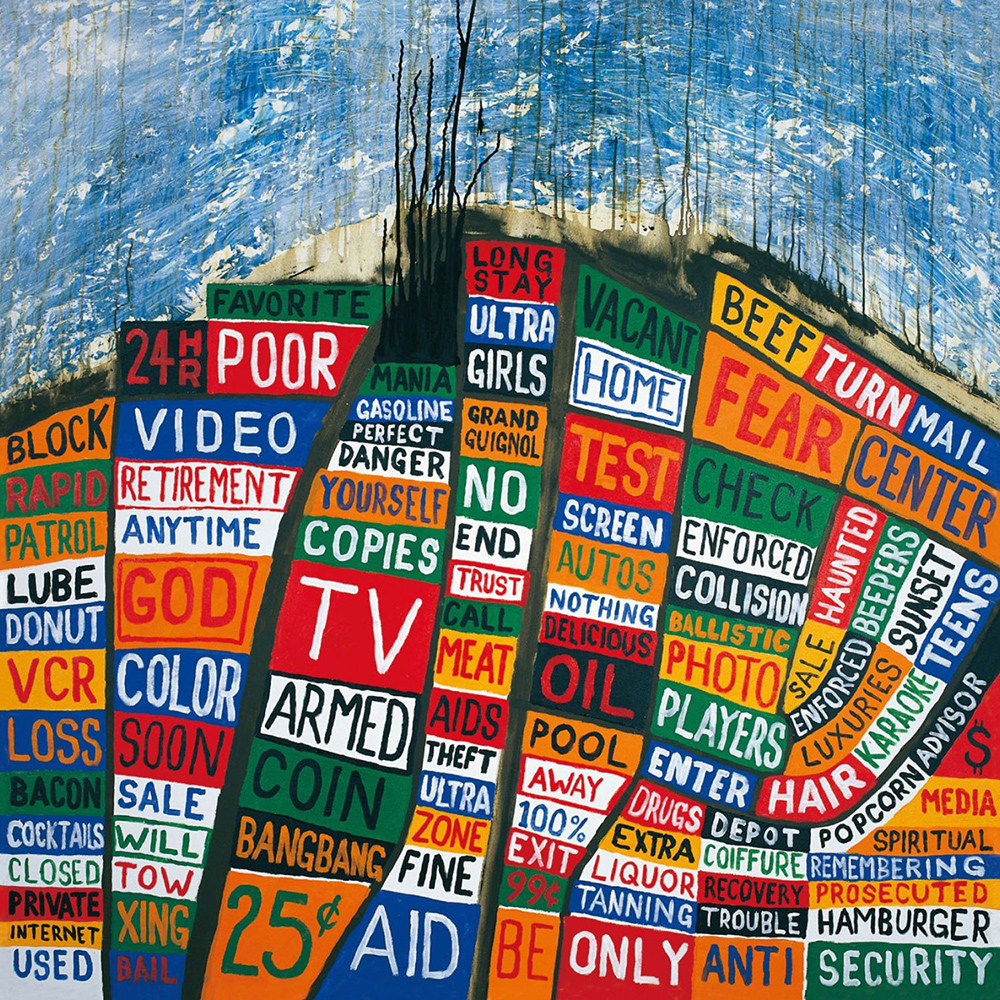
Radiohead albums tend to arrive with a built-in argument, not just about what the band is doing, but about what popular music is allowed to do at that moment. In 2003, after the great left turn of Kid A and the fragmented after-image of Amnesiac, the argument around Radiohead had hardened into an annoying binary: either you wanted the guitars back, or you wanted them gone for good; either you believed in “songs,” or you believed in “process.” Hail to the Thief doesn’t solve that argument so much as mock it. It is a record that keeps offering you a handle and then changing the weight distribution. It will give you a proper rock crescendo, then undercut it with a slogan, a glitch, a choral smear, a rhythm that won’t sit still.
That stubbornness is part of why it matters. Hail to the Thief has often been described—accurately, and a little lazily—as a bridge between the band-as-experimental-system and the band-as-five-people-playing. The more interesting truth is that it’s a bridge that keeps shaking under your feet. The surface reads “back to guitars”: drums played like drums, guitars that chime and grind without apology, choruses that behave like choruses. But the climate is still Kid A’s, that atmosphere of institutional dread, where even the warmest chord seems monitored.
The title, inevitably, dragged the album into the early-2000s political weather. It arrived in the Bush–Blair era and the lead-up/aftermath of Iraq; press of the time treated it as a provocation, a direct jab, a protest record. The band publicly complicated that reading—Jonny Greenwood, among others, played down the idea of a simple target—and you can hear why: the lyrics don’t do pamphleteering. They do something slipperier and, in its way, more accurate to how power actually feels when you live inside it. Hail to the Thief is full of bureaucratic language, media cadence, commands, reversals, the grammar of justification. It’s a record about systems less than villains, about what it’s like to be addressed by institutions—marketed at, policed by, reassured by, threatened by. It’s an album that uses the vocabulary of public life to describe a private nausea.
What makes that nausea compelling is that Radiohead dress it in pleasure. The opening, “2 + 2 = 5,” is a miniature of the album’s method: a slow accrual of tension until the song finally lets itself explode, as if the band have been holding their breath for two minutes and then remember they’re allowed to bite. It’s not merely catharsis; it’s a demonstration of control. The guitars don’t just return—they return with conditions, with a sense that the band are choosing when to allow the old satisfactions. In a decade that rewarded instant payoff, Radiohead make the payoff feel like a political act: you want release? Fine. Wait. Earn it.
If that sounds stern, the record isn’t. It’s funny in the way paranoia is funny when you recognize it. “Sit Down. Stand Up.” builds like a civic instruction manual read by someone who has stopped trusting the instructions. “Myxomatosis” lurches with a grotesque swagger, a bassline that feels like it’s been fed through a propaganda machine and come out thicker, meaner, slightly nauseous. And when the band go spectral—“Sail to the Moon” hovering on piano and dread—they don’t try to sell you transcendence. The song doesn’t float; it hangs, like a charm someone doesn’t believe in anymore but still wears.
Nigel Godrich’s production is crucial here, not as a signature “sound” but as a way of making coexistence believable. The album is full of moments that look straightforward and then reveal the lab work underneath: guitars that behave like guitars until the room around them turns wrong; drums that feel human until the groove starts to shiver; voices that sound intimate until they’re multiplied or treated like a broadcast. The trick is that the record rarely announces its studio intelligence with neon. It often hides it in plain sight, so the listener experiences the unease as something natural, not as “effect.” That’s why, even when the band appear to have returned to rock dynamics, the songs still feel surveilled.
Hail to the Thief is also inseparable from its era’s new kind of listening. An unfinished version leaked online roughly ten weeks before release, and the band publicly bristled—not at file-sharing as morality play, but at the idea of unfinished work becoming the version people lived with. That detail matters because the finished record carries a sense of urgency that can be misread as roughness. It was reportedly tracked quickly—often summarized as about two weeks for core sessions, with additional work later, including time at Ocean Way in Los Angeles and then further finishing in the UK—and you can hear both the speed and the aftercare. Some tracks feel like they were caught rather than constructed; others feel carefully framed, as if to keep the heat without letting it burn the tape.
The album’s most persistent criticism—that it’s too long, too sprawling, too much like a pile of excellent songs rather than a single, sealed world—isn’t wrong. It doesn’t have Kid A’s uncanny unity or OK Computer’s narrative glide. It feels like a file dumped on a desk: urgent, various, full of contradictions, sometimes repetitive in its emotional weather. But the sprawl is not simply a failure of editing; it’s also the point. The record’s structure resembles the world it’s describing: information overload, headline-to-headline anxiety, the way serious events are processed through a hundred competing channels until they become a buzzing in your teeth.
Take the electronic-leaning pieces—“Backdrifts,” “The Gloaming”—which don’t so much provide “variety” as they remind you what kind of band this became after 2000: one that can turn rhythm into a nervous system. These tracks don’t aim for the clean beauty of dance music; they aim for the sensation of being trapped in a room where the lights are too bright and the announcements keep changing. And then, perversely, the band will follow that with something that resembles old-fashioned craft—discernible verses, discernible choruses—as if to ask what those forms mean now. Is a chorus still a communal space, or just another mechanism for compliance?
The album’s darker comic set-piece, “We Suck Young Blood,” is where the record’s political aura becomes almost theatrical. It’s a funereal shuffle, emaciated, stubbornly withholding, punctured by a single outburst that feels less like relief than a spasm. On paper it’s a risky move—slow, processional, almost anti-melodic in its insistence. In practice it plays like a grotesque moral nursery rhyme for an economy that’s learned to speak in soothing tones while doing the opposite.
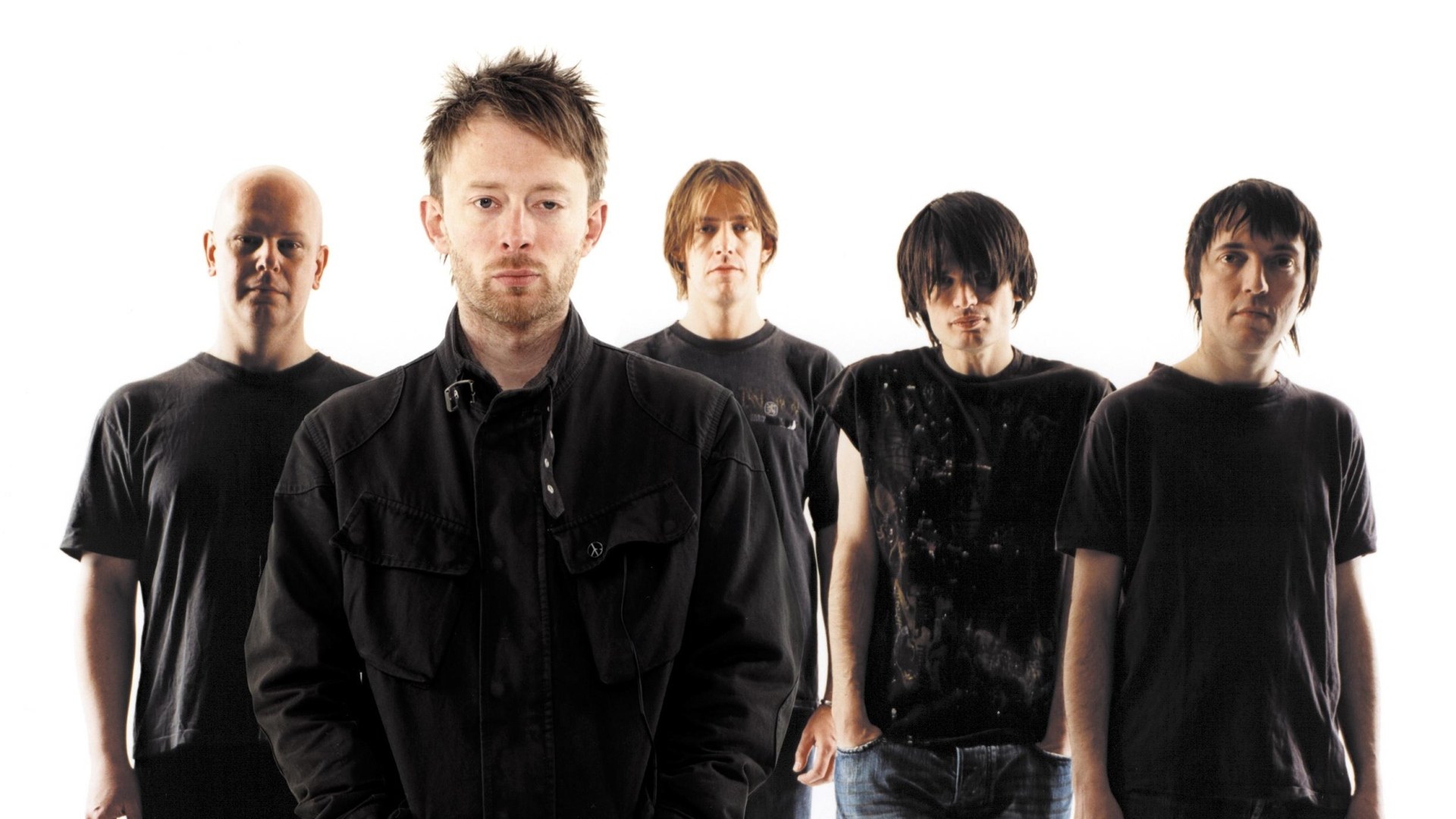
And yet for all its public-facing rhetoric, Hail to the Thief is also a record about the band themselves. After the self-mythologizing of OK Computer and the refusal of Kid A, this is Radiohead negotiating what it means to be Radiohead in real time: making a record that can hold both the old fans and the new obsessions without flattening either. You can feel the group testing their own muscles, enjoying the blunt force of guitars again, then quickly complicating the pleasure so it doesn’t become nostalgia. The result is not a neat synthesis; it’s a portrait of a band arguing internally and turning that argument into texture.
Culturally, it sits at a particular hinge. Released in June 2003, it arrived when the “political album” was often expected to deliver either righteous clarity or ironic detachment. Radiohead offer neither. They offer a sense of language itself becoming contaminated—of slogans, assurances, and commands crowding out honest speech. That’s why the album’s mood still lands: not because the headlines are the same, but because the feeling of being managed by narratives is.
If you want the cleanest Radiohead statement, Hail to the Thief will frustrate you. It’s nearly an hour long and sometimes behaves like it’s trying to outpace its own second-guessing. But its impact is substantial precisely because it refuses to streamline its anxieties into a tidy arc. The record doesn’t present a single environment; it presents a set of pressures. It’s the band’s argument album—less a monument than a dossier—where the pleasures of rock music and the unease of modern life are forced to share the same file folder. And somehow, against its own tendency to sprawl, it keeps you reading.