

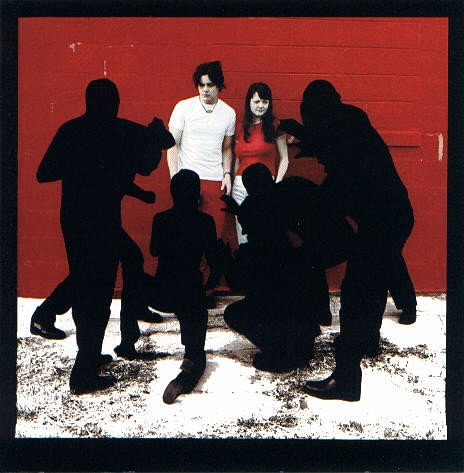
White Blood Cells arrived in 2001 with the particular kind of inevitability that only happens after the fact. At the time it was an indie record—first out on Sympathy for the Record Industry—behaving like a breakthrough before the industry had finished noticing. That tension is part of the album’s enduring pull: it’s a document of a band still moving by gut and principle, even as the world begins to treat them like a story. By the time it was re-released by V2 in 2002, the narrative had already calcified into something like gospel: two people, red-white-black iconography, no bass, old American music put through a cheap amp and a sharp mind. White Blood Cells doesn’t just benefit from that mythology; it tightens it, tests it, and—crucially—makes it entertaining.
The record’s great trick is how it sounds both raw and arranged. Garage rock revival, at its worst, was a fashion week of scuffed sneakers: gestures toward authenticity, riffs worn like vintage jackets. Here, the minimalism is less an affect than a compositional engine. Take away the bass guitar and you don’t just lose low end—you lose comfort. The music has to imply its own weight, and Jack White does that with riffs built like braces: simple shapes that hold the structure while leaving space for chaos. Meg White’s drumming, too often discussed as a limitation, works on this album like a signature typeface. She plays to the song’s blunt purpose, not its possible virtuosity. The result is a peculiar kind of swing: not loose, not tight, but adamant.
The sessions were cut at Easley-McCain Recording in Memphis in early 2001, a choice that matters less as pilgrimage than as practicality. Memphis is a city where American music history is both everywhere and beside the point; you can feel it in the air without needing to cosplay it. What you hear on White Blood Cells is not reverence but friction—tape and room tone, the sense of a real kit being hit hard, a guitar tone that doesn’t try to flatter itself. Later accounts have singled out engineering work at the studio (Stuart Sikes is often mentioned in local context), and whatever the precise division of labor, the album’s sound suggests people who understood the brief: make it hit harder without sanding off the splinters. It’s “bigger and tighter,” as contemporary reviews liked to say, but it’s not polite.
If the late ’90s and early 2000s were dominated by rock that sounded like spreadsheets—nu-metal’s chugging precision, radio-ready compression, the endless tyranny of “production value”—White Blood Cells offered an alternative idea of modernity: speed, contrast, and a refusal to thicken the arrangement just because you can. The album plays like a set of decisive moves. “Dead Leaves and the Dirty Ground,” the opener, is a manifesto disguised as a pop song: swaggering and slightly harried, with a hook that feels like it’s being dragged through gravel. It declares the band’s central ethic—directness—while letting in a new sense of control. You can hear the duo learning how to pace a record, not just how to survive a song.
That pacing matters because White Blood Cells is built on hard left turns. Plenty of bands can do loud. Fewer can alternate loud with tender without sounding like a novelty act. The White Stripes make that oscillation feel like character. “Fell in Love with a Girl” is the obvious example: a garage-pop detonation so immediate it barely qualifies as an arrangement. It’s over before your brain has finished naming the feeling, which is precisely the point. It’s not a love song in the traditional sense; it’s the bodily panic of attraction, the way desire can turn language into sputtering consonants. The recording doesn’t luxuriate—it lunges.
Then the album will calmly sit you down at a school desk. “We’re Going to Be Friends” is almost insolently sweet, a folk-pop vignette that refuses irony. Its McCartney-ish charm isn’t an imitation so much as a reminder that melody is older than cool, and Jack White, for all his fuzz and attitude, is fundamentally a melodist. The contrast between this and the surrounding stomps is what makes the album feel adult rather than adolescent. Adolescence often fears softness; White Blood Cells keeps walking straight into it.
“Hotel Yorba,” with its country-tinged bounce, extends that tenderness but complicates it. It’s domestic and ramshackle, romance imagined as a cheap room and a vow you’re not sure will hold. What the band gains by staying a duo is that every sentiment—every flirtation, every threat—lands without cushioning. There’s no lush harmony section to sanctify the feeling. When the song is warm, it’s warm because the writing is, not because the production has been instructed to glow.
The harder-edged material, meanwhile, shows Jack White’s knack for turning half-remembered American forms into personal theater. “The Union Forever” is the album’s most overt piece of myth-making, a snarling, slogan-ready number that folds cultural reference into a posture of defiance. It’s also where the album courts one of its few real problems: sometimes the self-awareness becomes a little too pleased with itself. White Blood Cells is at its best when it feels involuntary—when the music sounds like it’s happening faster than the band can explain it. When the concept steps forward, you risk hearing the outline of the project.
But even that risk is part of why the record mattered. In 2001, indie rock was beginning to professionalize—becoming a career track rather than a scrappy alternative. White Blood Cells offered a vision of success that didn’t require smoothing your voice into a product. You can hear the album thinking about fame without fully understanding it yet; its “meditations on fame, love, and betrayal” aren’t grand statements so much as quick flashes of defensiveness, yearning, bravado. It’s the sound of someone both craving an audience and mistrusting what that craving does to them.
Listen to the way the album keeps finding new shades of suspicion and self-sabotage. “I Think I Smell a Rat” is a vicious little engine of paranoia—comical in its bluntness, but also uncomfortably accurate as a portrait of a mind that can’t stop scanning for betrayal. The humour is important: Jack White’s writing here isn’t just melodrama; it’s melodrama with an eyebrow raised, the awareness that the persona is being performed even as it bleeds.
And yet, White Blood Cells isn’t flawless. For an album celebrated for concision, it can occasionally feel like it’s circling its own signature moves. The duo’s self-imposed limitations—no bass, minimal overdubs, a narrow palette of tones—create a thrilling discipline, but they also mean that some mid-album moments blur in texture, if not in intent. The record’s achievement is that the blur rarely becomes boredom; the songs are too hooky, the performances too brashly alive. Still, the album’s canonization sometimes treats it as a perfect object rather than a working band getting smarter in public.
What keeps it from museum status is its sense of proportion. White Blood Cells never tries to become a “statement album” in the heavy-handed way rock culture often demands. It’s more like a well-sequenced argument made out of riffs: that you can be minimal without being small, that you can be referential without being academic, that sweetness doesn’t cancel menace—it sharpens it. The album’s cultural placement in the garage-rock revival is real, but it’s not merely representative. Where many of its contemporaries offered style as a rebuttal to late-era excess, The White Stripes offered craft: songs that would still work if you played them on a broken acoustic or banged them out on a kitchen table.
It’s also worth remembering that early reception wasn’t uniformly worshipful. Alongside the rapture in tastemaking corners—documents of excitement that now read like a time capsule of the era’s hunger for something unprocessed—there were mainstream takes that found it less frantic, less urgent, perhaps even underwhelming compared to the hype. That dissent is useful. It reminds you that White Blood Cells isn’t a universal solvent; it’s a record with a specific temperament. It demands tolerance for repetition, for theatricality, for the peculiar intimacy of a duo who make their limitations audible.
But if you meet it on its own terms, it still feels like a jolt. Not because it’s louder or faster than what came before—history has caught up to its tricks—but because it models a rare kind of confidence: the confidence to do less, to do it harder, and to let the songs carry the weight. In a culture that keeps equating importance with scale, White Blood Cells remains a reminder that a band can change the weather with almost nothing. Two people. A room in Memphis. A handful of riffs and the nerve to believe they’re enough.