
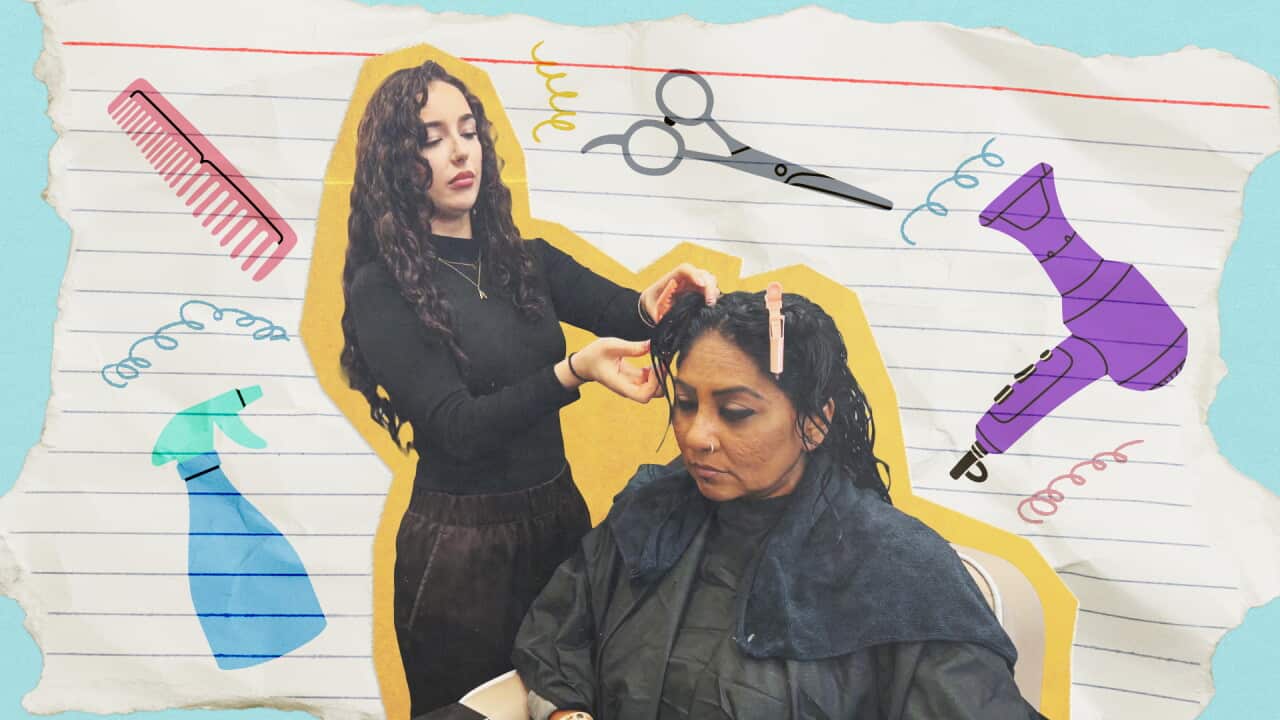
For Veronica Vazquez and her daughter Ivory, a haircut can require a two-hour journey. The destination is not a luxury salon or celebrity stylist but a hairdresser who knows how to work with their curls. Their experience is common enough to expose a structural gap in Australian hairdressing: the standard qualification has not reliably treated textured hair as standard knowledge.
Curl specialist Natasha Thandekafountas says many hairdressers complete their training with little practical confidence across different curl patterns. Skills may be available through electives, private courses or workplace experience, leaving competence to the interests of an apprentice or the clientele of a particular salon.
That arrangement creates a default customer. Straight or easily managed hair becomes the assumed foundation; curls and coils become an extension. The distinction affects more than the final look. Cutting technique, moisture, shrinkage, detangling and chemical history all influence whether a service is effective and safe.
Skills and Curriculum Services Australia is reviewing the national training standards. Proposed changes include three units addressing curly and coily hair, according to the SBS report. Educators including Fiona Beamish argue that broader training must be practical rather than a brief theoretical inclusion that leaves graduates no more confident at the chair.
The gap also has a cultural cost. Hair carries identity, family knowledge and racialised assumptions about what looks professional or cared for. A client who repeatedly has to explain the basics is not purchasing the same service as someone the curriculum anticipated from the start.
No qualification can make every graduate a specialist in every technique. Core training can, however, establish that human hair comes in a wide range of textures and that competent consultation begins before scissors touch it. Specialist excellence can build on that baseline; it should not be the only route to basic inclusion.
For families travelling across a city or region, the review is overdue. Its success will not be measured by the wording of new units but by whether the next generation of hairdressers gets enough supervised practice to welcome a client with curls without treating them as an exception.