
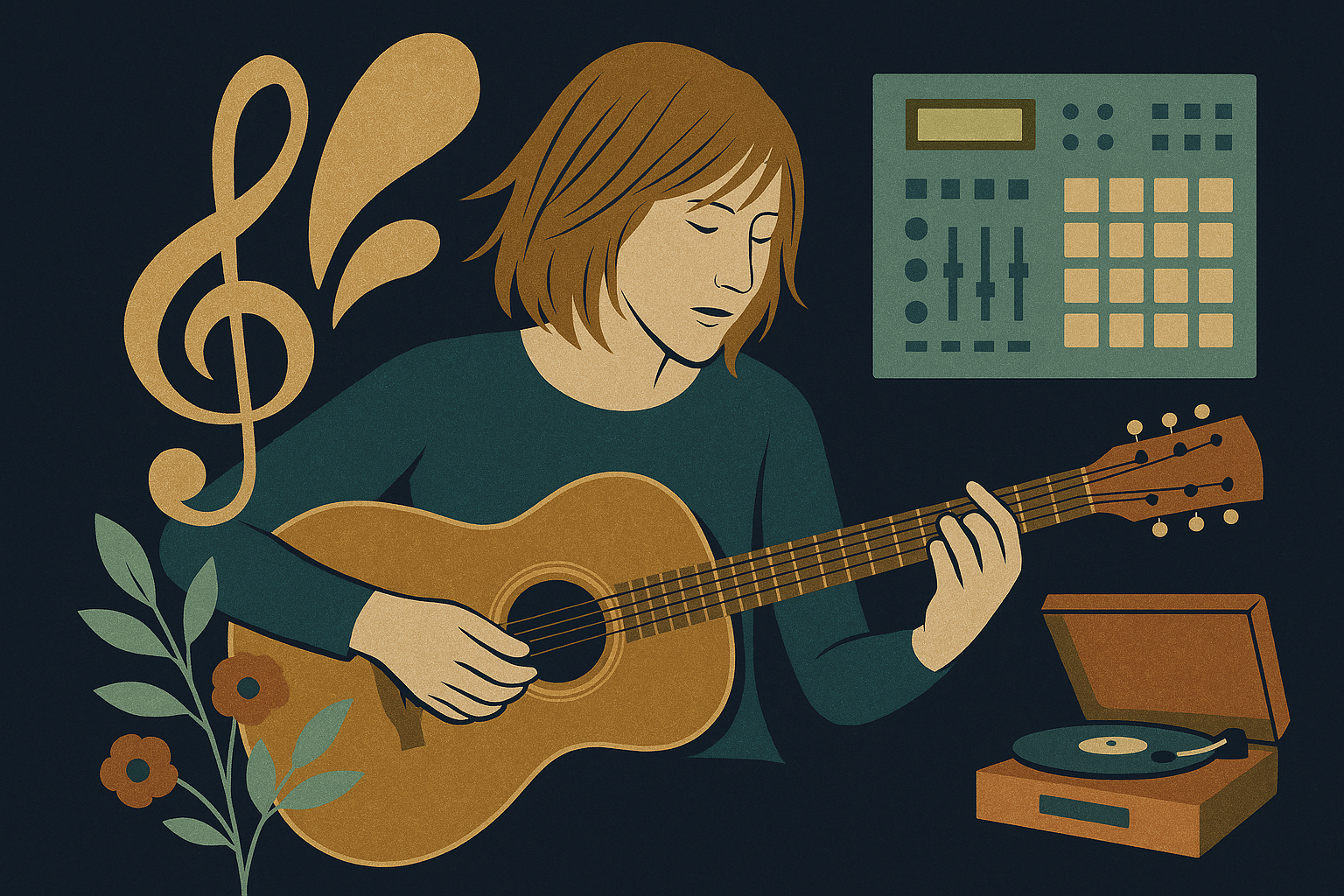
Beth Orton matters because she represents a version of British alternative music that’s easy to overlook: not the loud revolution, but the durable one. In the 1990s she helped define a new grammar for songwriting—acoustic, inward, traditionally “folk” in posture—yet embedded in the textures, edits, and bass pressure of electronic music. That hybrid didn’t just produce a few stylish records; it offered a blueprint for how a singer-songwriter could survive the end of the monoculture, moving between scenes without becoming a novelty.
The core idea: what “folktronica” was really doing “Folktronica” is often used as a neat label for “acoustic guitar + beats,” but the cultural work it did was broader. In mid-to-late 1990s UK music, dance culture and indie/folk were frequently treated as separate tribes—different venues, different drugs, different ideas of authenticity. Orton emerged in the overlap. She wasn’t the only artist exploring it (think of parallel experiments across trip-hop, post-rave ambient, and left-field pop), but she became one of the genre’s clearest human centers: her voice made the electronic framing feel like emotional infrastructure rather than a clever production trick.
The tension underneath the tag was always about authenticity. Folk culture often prizes “liveness” and tradition; electronic production foregrounds mediation, collage, and studio authorship. Orton’s early work didn’t resolve that contradiction so much as make it productive—turning the studio into a kind of modern campfire, intimate but unmistakably constructed.
Key albums and creative phases Orton’s 1996 debut Trailer Park is the classic entry point: a record where loops and gentle programming sit beside confession-like lyrics and melodic restraint. It helped establish her as a singular presence in an era when British electronic music was exporting a cool, often emotionally guarded aesthetic; Orton’s songs offered warmth without sentimentality.
Central Reservation (1999) sharpened the focus. It’s frequently remembered as her commercial and critical peak, but its deeper significance is how it stages a negotiation between club-adjacent sonics and traditional songcraft. Even when the rhythms push forward, the emotional pace stays human—hesitations, half-decisions, a voice that sounds like it’s thinking in real time.
In the years after, Orton’s work increasingly leaned toward band-based and folk-rooted arrangements. This shift is sometimes described as a retreat from experimentation, but it can also be heard as an artist refusing to be locked into a period style. Where Trailer Park and Central Reservation make a case for hybridization, the later, more acoustic work makes a case for continuity: the same sensibility—observant, restless, unromantic—carried by different tools.
Collaborations and cross-genre influence Orton’s early career was notably porous: she moved through scenes rather than declaring allegiance to one. Collaborations with electronic producers and remix culture helped her songs circulate outside the singer-songwriter economy of radio sessions and album reviews. That matters because it changed the implied audience for “folk” writing: not just attentive listeners at home, but people encountering a vocal line inside a DJ-adjacent continuum.
The bigger cross-genre influence is structural: Orton’s model foreshadowed the 2000s and 2010s normalisation of genre-fluid singer-songwriters, where acoustic writing can coexist with sampling, programming, and ambient sound design. It’s hard to draw a straight line of credit in pop history—claims of “pioneering” are often contested, and scenes evolve collectively—but Orton’s catalogue is one of the clearest early demonstrations that the hybrid could be emotionally convincing, not just aesthetically novel.
Songwriting voice: themes, stance, and the kind of intimacy she offers Orton’s writing tends toward the interior: desire, self-scrutiny, the push-pull between leaving and staying, the mood-shifts of memory. What distinguishes her isn’t diaristic confession for its own sake; it’s a tone of ambivalence that feels adult. Many singer-songwriters resolve pain into catharsis. Orton often leaves it partially unresolved, which can feel truer to how people actually change.
Her voice—both literal and artistic—also resists the performance of certainty. In a music economy that rewards branding, her work has often sounded like someone prioritising perception over persona. That restraint is part of why the songs age well: they don’t rely on trend-specific attitude.
The live debate: did folktronica open doors—or become a box? A lingering question is whether the “folktronica” label helped Orton (and peers) by giving critics a handle—or reduced the music to a niche. Genre tags can create scenes, playlists, and touring circuits. They can also freeze an artist in time, implying the “real” work happened in one fashionable moment. Orton’s post-1990s trajectory tests that tension: the more she moved toward traditional forms, the more some listeners treated it as a departure rather than an evolution.
There’s a second debate about technology and sincerity. As AI-assisted production and hyper-processed vocals spread, older anxieties about the “realness” of acoustic performance are resurfacing in new forms. Orton’s early records offer a useful counterpoint: they suggest that mediation doesn’t automatically erase intimacy; it can frame it, sometimes more honestly than a faux-live aesthetic.
What’s often missed or misunderstood First, Orton is sometimes treated as a bridge between two worlds, when she’s better understood as evidence that the worlds were never fully separate. UK music culture has long been hybrid (dub, post-punk, rave, indie, folk traditions), and Orton’s career is part of that ongoing conversation.
Second, the “electronic vs acoustic” storyline can obscure the more consistent throughline: her commitment to songwriting as a craft. Production aesthetics shift; her melodic sense and emotional precision remain.
Third, the cultural contribution isn’t only sonic. It’s also about permission: for women in alternative music to occupy both the introspective singer-songwriter role and the experimental studio role without being treated as an exception, a muse, or a guest vocalist.
Timeline: 6 milestones - 1996: Trailer Park introduces Orton’s early hybrid of acoustic songwriting and electronic production. - 1999: Central Reservation consolidates her wider cultural profile and becomes a defining reference point for the era’s cross-genre possibilities. - Early 2000s: A gradual shift toward more band-forward, folk-leaning arrangements—less about scene-fashion, more about song durability. - 2010s: A renewed appreciation as genre boundaries soften across indie, electronic, and singer-songwriter ecosystems. - 2020s: Continued relevance in a streaming era that rewards mood and texture—areas where her catalogue performs unusually well. - Present: Her work is increasingly framed not as a period piece of the 90s, but as part of a longer lineage of UK experimental songwriting.
Recommended listening (starting points) - “She Cries Your Name” (Trailer Park): the signature balance of intimacy and modern production. - “Central Reservation” (Central Reservation): a concentrated statement of her late-90s aesthetic and emotional pacing. - A later, more folk-leaning album cut or live session: to hear how the songs stand when the electronics recede, revealing the craft underneath.
Questions to keep open 1. When does a genre label (like “folktronica”) create real cultural space—and when does it flatten the artist it describes? 2. What counts as “authentic” in an era where both acoustic performances and electronic productions can be equally constructed? 3. How should we measure influence for artists who shape sensibilities and methods more than charts or headlines? 4. Does the streaming era reward Orton’s kind of subtlety—or does it risk turning textured songwriting into background mood? 5. What new forms of hybrid songwriting might emerge as production tools become more automated, and how might Orton’s approach guide what we value?