
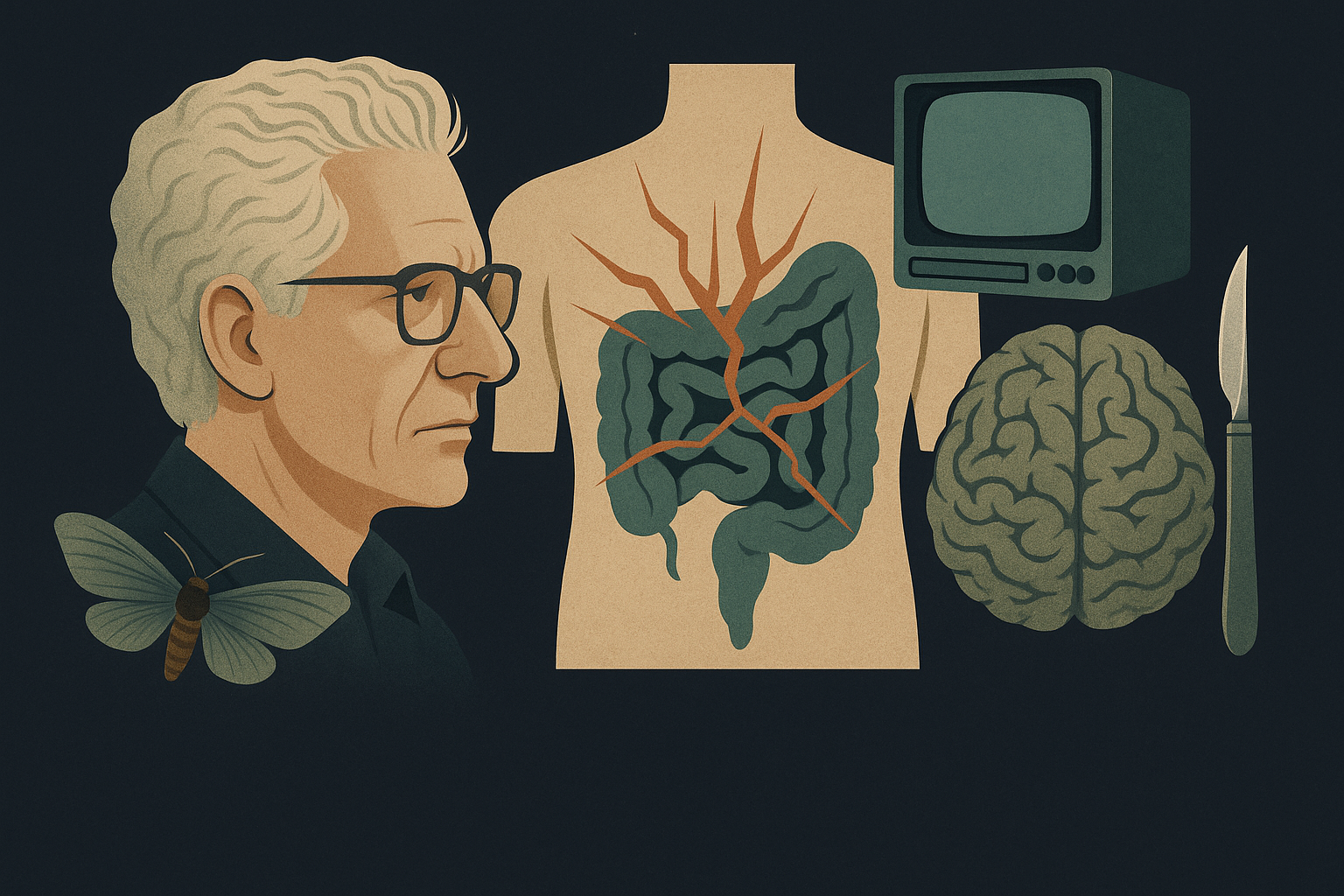
David Cronenberg matters because he made a certain modern anxiety—about bodies, machines, desire, and selfhood—feel unnervingly concrete. Where many directors treat horror as an external threat, Cronenberg’s signature move is to place the disturbance inside us: in biology, in perception, in the stories we tell ourselves to stay coherent. Over five decades, he has moved from cult shock to arthouse prestige without abandoning the central question that drives his work: what happens when the boundary between “me” and “not-me” breaks down?
The core idea: the body as a site of change Cronenberg is often introduced via the shorthand “body horror,” but that label can mislead. The gore (when it appears) is usually a vehicle for something more philosophical: the body as a porous interface between mind and world, and as a political object shaped by medicine, media, and institutions. His films repeatedly ask whether identity is stable—or whether it’s a temporary truce between impulses, technologies, and social roles.
That concern connects early, low-budget Canadian projects to later, cooler thrillers and dramas. Even when the imagery becomes restrained, the underlying preoccupation persists: transformation, contagion (literal or social), and the unsettling possibility that “normal” is only a thin aesthetic preference.
Essential films (early to late), with why they matter - Shivers (1975): A parasite in a high-rise triggers a breakdown of social order and sexual restraint; significant as an early, controversial statement of Cronenberg’s interest in biology as destiny and in suburban modernity as fragile. - Rabid (1977): After experimental surgery, a woman becomes a vector for an epidemic; significant for tying medical intervention to fear of contagion and the ethics of “fixing” bodies. - Videodrome (1983): A TV executive encounters a broadcast that seems to rewire perception and flesh; significant as a prophetic media critique—less about gadgets than about how images can colonise desire. - The Fly (1986): A scientist’s experiment goes wrong and transformation follows; significant as Cronenberg’s most emotionally direct film, often read (plausibly, though not definitively) through illness, aging, and grief. - Dead Ringers (1988): Twin gynaecologists spiral into obsession and collapse; significant for its psychological intensity and for showing Cronenberg can disturb without relying on monsters. - Crash (1996): People form a subculture around car-crash eroticism; significant for its cool, clinical style and for the ongoing debate about whether it critiques or simply depicts transgressive desire. - A History of Violence (2005): A small-town man’s past complicates his present; significant for signaling a late-career shift toward tight, classical thrillers while keeping identity and reinvention at the center. - Eastern Promises (2007): A midwife uncovers violent networks and contested loyalties; significant for its moral ambiguity and for its focus on bodies as records—marked by labour, violence, and belonging.
Milestones, acclaim, and collaborators Cronenberg emerged from Canada’s 1970s film ecosystem—supported in part by national institutions that helped auteurs take risks outside Hollywood’s commercial logic. By the 1980s, he had become internationally recognisable, with The Fly cementing mainstream visibility.
His prestige era is often anchored by festival recognition: Crash won the Jury Prize at Cannes (1996), and A History of Violence and Eastern Promises deepened his reputation as a major dramatist, not merely a genre provocateur. A key collaborator in his later period is Viggo Mortensen, whose restrained performances suit Cronenberg’s interest in surfaces—how calm civility can sit on top of chaos.
There’s also a stylistic arc worth noting. Early Cronenberg leans into grimy, tactile textures; later films often adopt a cleaner, more “respectable” look. Some critics see this as a loss of subversive energy; others view it as a strategic evolution—smuggling radical ideas into familiar forms.
The live tension: critique, complicity, or something else? A recurring argument around Cronenberg is whether his films judge their characters’ desires or simply observe them. Crash is the flashpoint: detractors call it cold or exploitative; defenders argue its distance is the point, forcing viewers to confront how modern life eroticises risk, speed, and trauma.
More broadly, Cronenberg’s neutrality can feel like provocation. He rarely provides moral signposts, and that raises a genuine interpretive question: when a film depicts extreme transformation or taboo desire with precision and calm, does that undermine critique—or make it sharper by refusing comforting reassurance? The disagreement matters because it changes what we think cinema is for: moral instruction, psychological exploration, or cultural diagnosis.
What people often miss First, Cronenberg is not “anti-technology” in any simple way. His films are fascinated by how tools become extensions of the self—sometimes liberating, sometimes deforming, usually both. Second, the “body horror” is frequently empathetic rather than sadistic. The Fly, for example, is widely remembered for its effects, but its staying power comes from its intimacy and sorrow.
Third, Cronenberg’s work is deeply social. His stories are full of institutions—clinics, labs, media companies, criminal networks—that shape what kinds of bodies and identities are allowed to exist. In that sense, the films are not just personal nightmares; they’re cultural X-rays.
Legacy and influence Cronenberg helped legitimise horror and the grotesque as vehicles for serious ideas, clearing space for filmmakers who blend genre with philosophy and social critique. His DNA is visible in modern “elevated horror” and prestige genre TV: the emphasis on transformation as metaphor, the cool observational tone, and the refusal to tidy up moral ambiguity. Directors such as Julia Ducournau (notably in Titane) and many contemporary sci‑fi and horror creators echo his interest in flesh, identity, and the seductive danger of new experiences.
At the same time, his legacy is contested. Some celebrate him as an anatomist of modernity; others argue his clinical gaze can flatten characters—especially women—into ideas. That debate remains active, and it’s part of what keeps his work alive: Cronenberg is a director you can admire, resist, and revisit, often in the same sitting.
Where to start (three entry points) - For accessible, emotional sci‑fi horror: The Fly (1986) - For prestige crime/thriller craft with Cronenberg’s identity obsession: A History of Violence (2005) - For the pure, heady “Cronenberg effect” (media + body + philosophy): Videodrome (1983)
Questions to keep open 1. When a film presents transgressive desire without clear moral framing, does that expand understanding—or risk normalising harm? 2. Is Cronenberg best read as a prophet of technology’s effects, or as a diagnostician of older human impulses that technology merely amplifies? 3. Do his later, more classical films represent artistic maturation—or a strategic retreat from the unruly strangeness that made him singular? 4. How should contemporary viewers weigh auteurist fascination with bodies against evolving norms around representation, consent, and exploitation? 5. If identity is always in flux, what—if anything—counts as a “true self” in Cronenberg’s universe?