
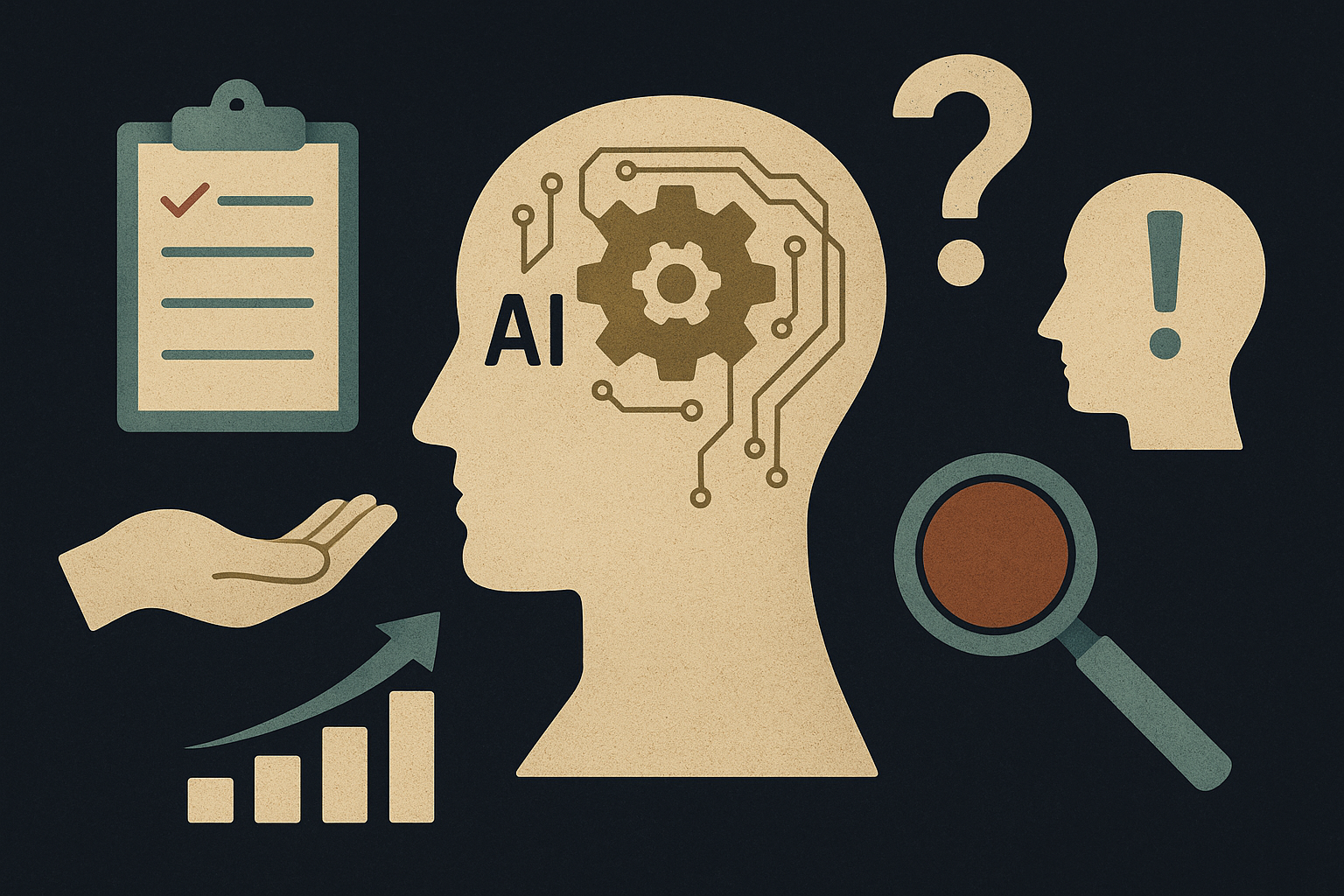
A recurring pattern in AI failures is not that a system is always wrong—it’s that it doesn’t reliably know when it might be wrong. A model that answers confidently when the situation is unusual, the data is missing, or the stakes are high can be worse than a model that sometimes fails outright, because it invites over-trust. That is why “artificial metacognition” has become a serious research target: not smarter answers, but better self-monitoring that makes AI use more predictable and governable.
What artificial metacognition is (in plain language) Artificial metacognition refers to mechanisms that let an AI system monitor, evaluate, and adjust its own reasoning or outputs during a task. Think of it as a reliability layer that asks: “How sure am I, why, and what should I do next?”—and then acts on that assessment by slowing down, seeking more information, flagging uncertainty, abstaining, or escalating to a human.
This is different from two things people often conflate:
1) Confidence scores. Many systems output probabilities or “confidence” values. These often reflect internal model statistics (e.g., softmax probabilities) that can be poorly calibrated: high confidence can still be wrong, especially under distribution shift. Metacognition aims for decision-relevant uncertainty: not just a number, but policies like “defer when uncertain,” with tests showing it helps.
2) Chain-of-thought-style reasoning. Exposing intermediate steps can improve performance, but it does not guarantee that the steps are faithful or that the model can detect its own errors. A fluent rationale can be post-hoc storytelling. Metacognition is about error detection and control: identifying brittle points and changing behavior (verify, search, ask, abstain), not merely producing an explanation.
One short vignette: imagine an AI assistant helping a nurse triage symptoms. A standard model might give an answer plus a confidence score. A metacognitive system would also recognize when the case falls outside its training (rare drug interaction, ambiguous symptoms), request a missing vital sign, run a secondary check, and—if uncertainty remains—route the case to a clinician with a clear “here’s what I’m unsure about” note.
Why researchers are pushing this now Three forces are converging.
High-stakes deployment is outpacing evaluation. As models move into health support, finance ops, security triage, and public services, the cost of “confidently wrong” rises. Labs and institutions (including academic groups in uncertainty quantification and AI safety, and industry teams building agentic workflows) are chasing methods that fail gracefully.
Agentic systems amplify small mistakes. Tool-using assistants and autonomous workflows can take a minor misconception and turn it into a cascade: wrong retrieval → wrong plan → wrong action. Metacognition is attractive because it can add “circuit breakers”: verification steps, budgeted deliberation, and abstention.
Reliability is becoming a product and governance requirement. Buyers increasingly ask for calibration, auditability, and escalation policies. Regulators are also paying attention to demonstrable risk controls, not just model size or intent statements.
The key tension: can self-evaluation be trusted? The central debate is whether a model (or a tightly coupled system) can reliably judge its own outputs.
Optimists point to practical successes: ensembles, debate-style checking, verifier models, uncertainty-aware training, and tool-based verification (retrieval, calculators, unit tests). There is evidence that structured “reflect-then-check” pipelines can reduce certain error types.
Skeptics emphasize a hard problem: if the same underlying biases and blind spots generate an answer, they may also generate a reassuring self-assessment. A model can “hallucinate” not only facts, but also justifications for trusting itself. This is especially worrying when metacognitive signals are used as gates for automation.
A pragmatic middle view is emerging: metacognition works best when it is not purely introspective. Systems that ground checks in external evidence (retrieval with citations, sandbox execution, independent verifiers trained on error detection, red-team style adversarial evaluation) tend to be more robust than systems that merely “think harder.”
What is often missed or misunderstood Metacognition is not AI self-awareness. The term can sound philosophical, but in engineering practice it usually means measurable control loops: calibration, abstention, and verification strategies.
“More reasoning” isn’t the same as “more reliability.” Longer rationales can increase surface plausibility without increasing correctness. In some settings, suppressing or constraining rationales while improving verification may be safer.
Good metacognition can look like humility—and users may dislike it. Abstaining, asking clarifying questions, or escalating to humans can feel slower or less magical. Product teams face a trade-off between user delight and dependable behavior.
Distribution shift is the stress test. Many methods look strong on benchmark-like data but degrade when inputs change (new slang, novel malware families, unusual medical presentations). Metacognitive policies must be evaluated specifically under shift, not only in-distribution.
Near-term use cases (where it could matter soon) - Health triage and clinical documentation support: uncertainty-aware prompts for missing info; hard rules for escalation; refusal to provide differential diagnoses without sufficient context. - Customer support escalation: detect ambiguous or high-risk issues (billing disputes, legal threats, safety complaints) and route to trained agents with concise uncertainty notes. - Robotics and autonomy: “stop and ask” behaviors when sensor data conflicts; safe fallback modes when confidence collapses. - Cybersecurity triage: rank alerts with calibrated risk; flag low-evidence attributions; force secondary validation before containment actions. - Scientific and coding assistants: require executable checks (tests, unit conversions, citation retrieval) and abstain when verification fails.
Risks and limits - Over-trust via polished self-assessments: a system that sounds cautious can still be wrong; “I’m 80% sure” may be meaningless if calibration is poor. - Gaming the evaluator: if models learn what “good uncertainty” looks like to a reward model or rubric, they may optimize appearances rather than truth. - Privacy and surveillance concerns: metacognitive monitoring can incentivize more logging (user inputs, decision traces, uncertainty markers), raising data retention and governance questions. - Failure under shift: the metacognitive layer itself can be brittle; abstention thresholds tuned on one domain may misfire elsewhere.
Signals to watch in the next 6–12 months - Benchmarks that test abstention and calibration under shift: not only accuracy, but “selective prediction” metrics (performance when the model is allowed to defer), and robustness suites. - Eval methods that separate explanation from correctness: faithfulness checks, adversarial probing, and verifier-vs-generator comparisons. - Product features becoming standard: calibrated uncertainty reporting, configurable abstention/escalation, provenance/citations, and tool-based verification by default. - Regulatory and procurement language: requirements for audit trails, escalation policies, and measurable reliability claims (rather than vague “safe AI” statements).
Questions to keep open 1) What kinds of self-checks generalize across domains, and which must be domain-specific (medicine vs. security vs. finance)? 2) How should systems communicate uncertainty to humans without causing either complacency or alarm fatigue? 3) Can we build verifiers that remain independent, or do they inevitably inherit the generator’s blind spots? 4) What is the right balance between logging for accountability and minimizing data collection for privacy? 5) Under real distribution shift, do abstention policies reduce harm—or do they simply shift work and liability to humans in uneven ways?
Three takeaways for product leaders and policy teams - Treat metacognition as a control system: require evidence it improves outcomes (calibration, abstention, escalation), not just nicer explanations. - Evaluate under shift and adversaries: test the “I’m unsure” behavior where it matters—novel inputs, edge cases, and incentive to game metrics. - Design governance into the loop: define who receives escalations, what gets logged, and how uncertainty claims are audited and updated over time.