
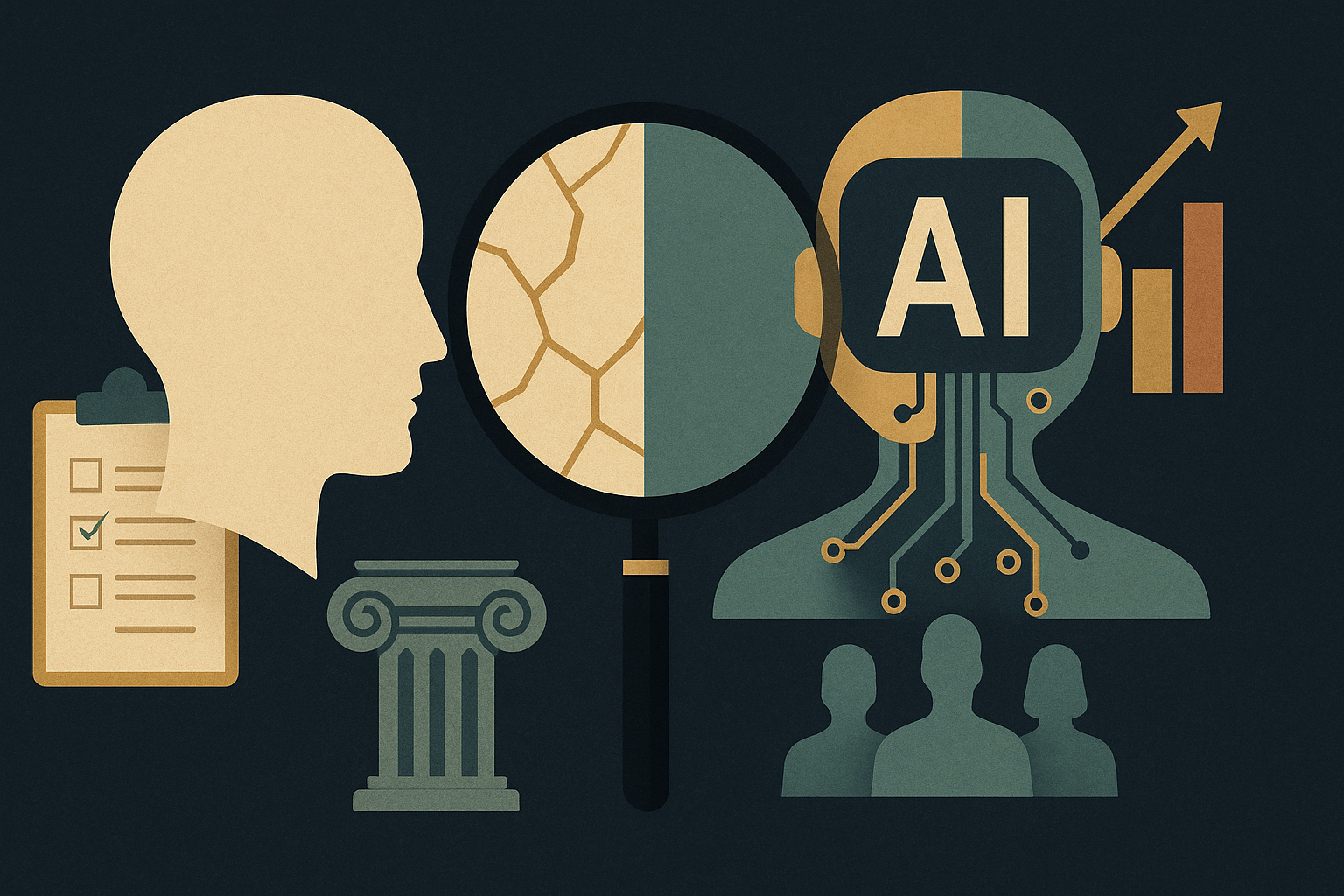
The social sciences run on a fragile bargain: we infer what people think and do from imperfect traces—surveys, interviews, administrative records, lab tasks, social media posts—then we argue about what those traces mean. AI breaks that bargain in two directions at once. Used carelessly, it can accelerate the production of convincing nonsense and contaminate the very data streams researchers depend on. Used carefully, it could raise the floor on measurement, replication, and error-checking. A Nature news feature frames the moment bluntly: AI can “whip up spurious findings and pollute survey responses,” yet it might also make research more rigorous.
The core issue: AI as both microscope and smog machine The document’s central idea is a double-bind. Modern machine-learning systems make it cheaper to do tasks that the social sciences have traditionally treated as costly and therefore scarce: coding qualitative data, generating stimuli and survey items, exploring large datasets for patterns, translating texts, simulating agents, and drafting papers. That “cheapness” is the opportunity.
But the same cheapness changes incentives and weakens safeguards. Machine learning can:
- Multiply false positives: if researchers (or institutions) can test thousands of model specifications, prompts, and datasets quickly, it becomes easier to find a publishable pattern that is statistically or substantively flimsy. - Pollute inputs: if large numbers of survey responses or open-ended answers are produced by bots or people using text generators, the empirical bedrock of many fields becomes less trustworthy.
The deepest problem isn’t that AI “makes errors.” The social sciences are already built to handle error. The problem is that AI can make error systematic, scalable, and hard to detect, while also producing outputs that look, stylistically, like competent scholarship.
The live debate: a crisis of inference, not just a tooling upgrade Underneath the headline question—ruin or revolution—is a more technical dispute about what counts as evidence, and how we know when we’ve learned something real.
1) Spurious findings, turbocharged The Nature piece highlights a classic risk: machine learning can make it easier to generate results that are statistically impressive but conceptually empty. Social science already struggles with:
- Multiple comparisons and p-hacking (searching a garden of analytical paths until something “works”) - Overfitting (a model that describes the dataset rather than the world) - Measurement drift (what a proxy captures changes over time)
AI amplifies these because it encourages wide, rapid exploration—especially in high-dimensional settings (many variables, many choices). The contested question is whether the field’s existing defenses—pre-registration, robustness checks, out-of-sample validation, replication—will scale up to match.
A plausible optimistic interpretation (also present in the article’s framing) is that machine learning can force better habits: stronger validation, explicit holdout sets, and prediction benchmarks. A pessimistic interpretation is that it will mostly raise the volume of “results” without raising the signal.
2) Survey responses in the age of generated text If surveys and experiments are fed by human attention, AI changes the food chain. Two problems intertwine:
- Automation: bots can fill surveys, especially those routed through online panels or open recruitment links. - Assisted responding: even when a real person participates, they might use a model to generate open-ended responses, making “text as data” less like a window into cognition and more like a reflection of whatever tool they used.
This is not merely fraud detection. It’s a conceptual problem: many methods assume that a participant’s words are their own, produced under experimental conditions. If the words are co-produced by an external system, what exactly is being measured—attitudes, compliance, tool-use skill, or something else?
Some researchers will argue that this is simply the next step in a long history of survey artifacts (social desirability bias, satisficing, straight-lining). Others will insist it’s qualitatively different because the response can be fluent and coherent while being unmoored from the participant’s beliefs.
3) Rigor as an application, not a side effect The document’s hopeful strand is that AI could strengthen research—if used as an instrument of discipline rather than convenience. Concretely, machine learning can support:
- Better measurement: improving coding reliability, detecting inconsistent responses, and summarizing large corpora in ways that are auditable. - Error detection: scanning for anomalies, duplicated text, or patterns consistent with automation. - Transparent synthesis: assisting systematic reviews and meta-analyses—useful, but only if provenance and uncertainty are clearly handled.
The tension here is cultural. The “replication crisis” (famously discussed in psychology and adjacent fields) led to reforms such as open data, pre-registration, and registered reports. AI could extend those reforms—or it could provide new ways around them (for example, rapidly generating post hoc rationales or “story-first” hypotheses).
What tends to be missed Three misunderstandings often sneak into public conversation, and the Nature framing helps correct them.
1) “AI will replace social scientists” is the wrong focal point The more immediate issue is not replacement; it’s the integrity of the research pipeline. A discipline can keep all its jobs and still lose epistemic credibility if:
- Data sources become untrustworthy - Analysis becomes a search engine for significance - The literature becomes saturated with plausible but brittle claims
The threat is systemic: incentives, publication norms, and the ease of producing “paper-shaped objects.”
2) Polluted data is not only a technical bug—it changes what populations mean If survey respondents increasingly include bots, or humans relying on generators, the sample no longer represents “people” in the same way. That has downstream consequences:
- Trendlines over time may partly measure changes in data generation technology. - Cross-cultural comparisons may reflect differences in access to tools or norms of using them. - Measures that once correlated with education, trust, or political engagement may become confounded with “ability to sound fluent.”
Even perfect bot detection won’t fully restore the earlier world, because the boundary between “human response” and “tool-assisted response” is becoming socially normal in many contexts.
3) The hardest part is auditability In social science, the persuasive force of a finding often rests on the chain from concept → operationalization → data → model → interpretation. AI can weaken each link unless researchers can answer basic questions:
- Where did the text/data come from? - What transformations were applied? - What prompts, models, and parameters were used? - How sensitive are results to alternative choices?
The open question is whether the field will converge on standards for documentation and disclosure that are as routine as reporting sample sizes or confidence intervals.
Closing: a fork in the methodological road The Nature feature presents AI as a stress test for disciplines that already struggle to balance creativity with constraint. Social science advances when it produces new lenses on human behavior—but it only keeps public trust when it can show that those lenses are not distorting mirrors.
AI will likely do both: increase the rate of idea generation and the rate of error. Whether that net effect is “ruin” or “revolution” depends less on model capability than on governance: journal policies, funding norms, shared detection infrastructure, and the willingness to treat data provenance and analytic restraint as first-class scientific contributions.
Questions to keep open 1. What should count as an acceptable “human” response in surveys and experiments when tool-assisted writing becomes commonplace? 2. Can social-science publishing adapt its incentives fast enough to reward careful validation and replication over rapid pattern-finding? 3. What documentation standards (prompts, model versions, training-data disclosures where possible) are necessary for AI-assisted analyses to be auditable? 4. How do we distinguish genuine theoretical insight from fluent post hoc storytelling when AI makes narrative coherence cheap? 5. Which parts of the social-science toolkit—surveys, lab experiments, ethnography, administrative data—are most resilient to AI-driven contamination, and why?